How echoey is your classroom? Try the clap test
Updated 5 min read
Clap your hands once in an empty classroom and listen. In some rooms the sound stops almost at once. In others it rings off the walls and hangs in the air before it fades. That lingering sound is echo, and it makes it harder for learners to follow what is said.
Why echo matters in class
When sound lingers, each word runs into the next and speech blurs. Hard, flat surfaces such as brick, tiles, glass and bare ceilings bounce sound back into the room. Soft, porous materials such as felt soak some of it up each time, so it fades sooner.
Children feel it more than adults do. Research finds that noise and echo make listening and understanding harder for children than for adults, and harder still for learners working in a second language and children with language or attention difficulties.
Overseas standards set a target: in a classroom, a clap should fade in about six tenths of a second.
Try it by ear first
You don't need any equipment to get a feel for your room. Stand near the middle of the empty classroom with the doors and windows closed, give one sharp clap with flat palms, and listen. If the clap stops almost at once, the room is probably fairly calm. If you can hear it ring, flutter or hang in the air, the room is echoey.
Then measure it with the clap test
Our free clap test turns that clap into a number. Open it on your phone in the classroom, press Start and allow the microphone. Clap once when it asks, stay quiet for two seconds while the echo fades, and do that three times. It shows how long your room takes to go quiet, against the target.
For a good reading:
- Use the room empty, with the furniture in place.
- Close the doors and windows, and switch off fans or air conditioners if you can.
- Stand near the middle of the room. Rest your phone on a desk or shelf near you, or ask a colleague to hold it, about an arm's length from where you clap.
- Make one sharp clap, then stay quiet for two seconds.
Your claps stay on your phone unless you choose to send them to our team at the end. A phone gives an estimate, not a professional measurement, and it may be a little out. It is still a quick, honest first look at a room.
What a school in Johannesburg found
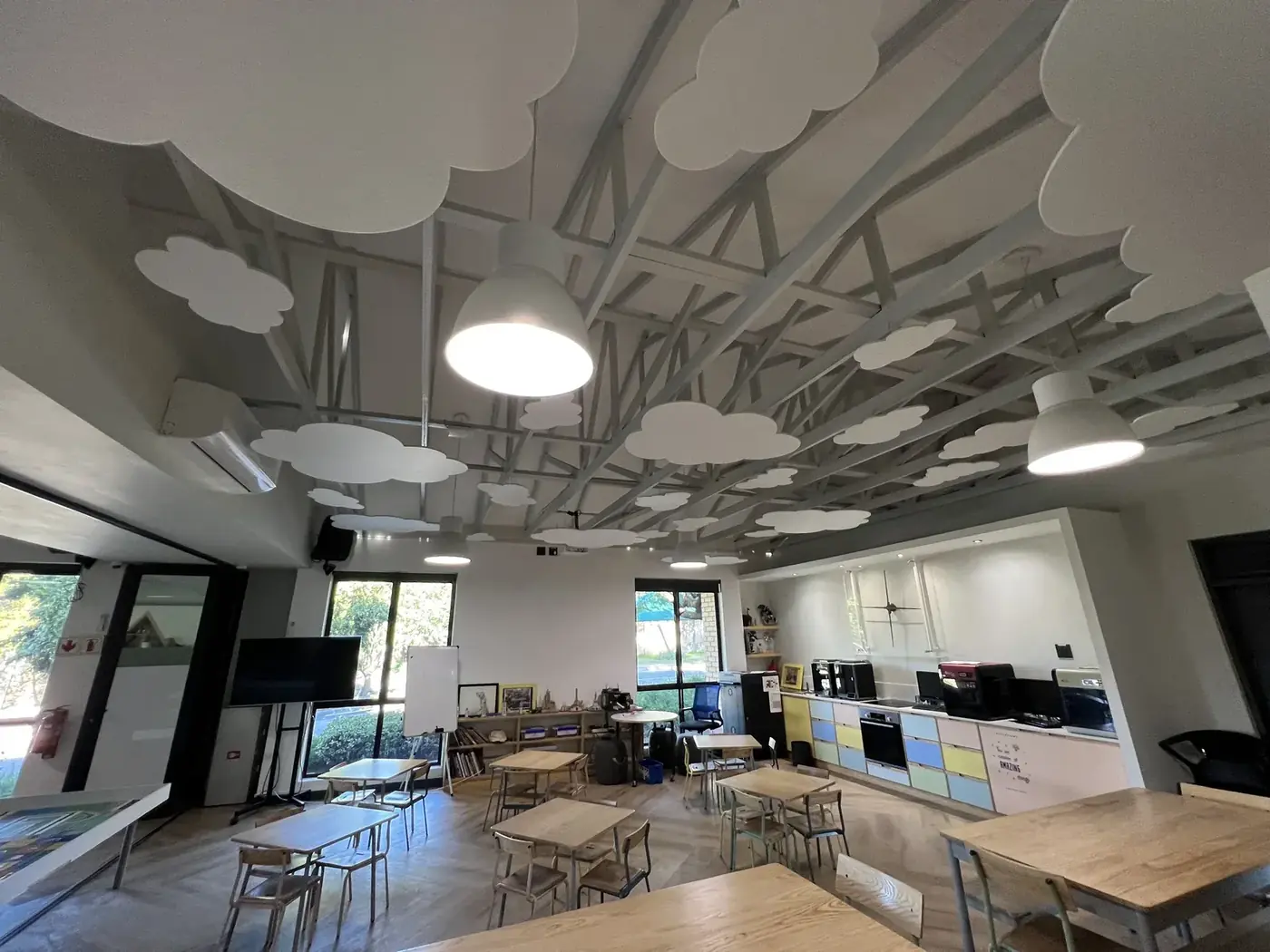
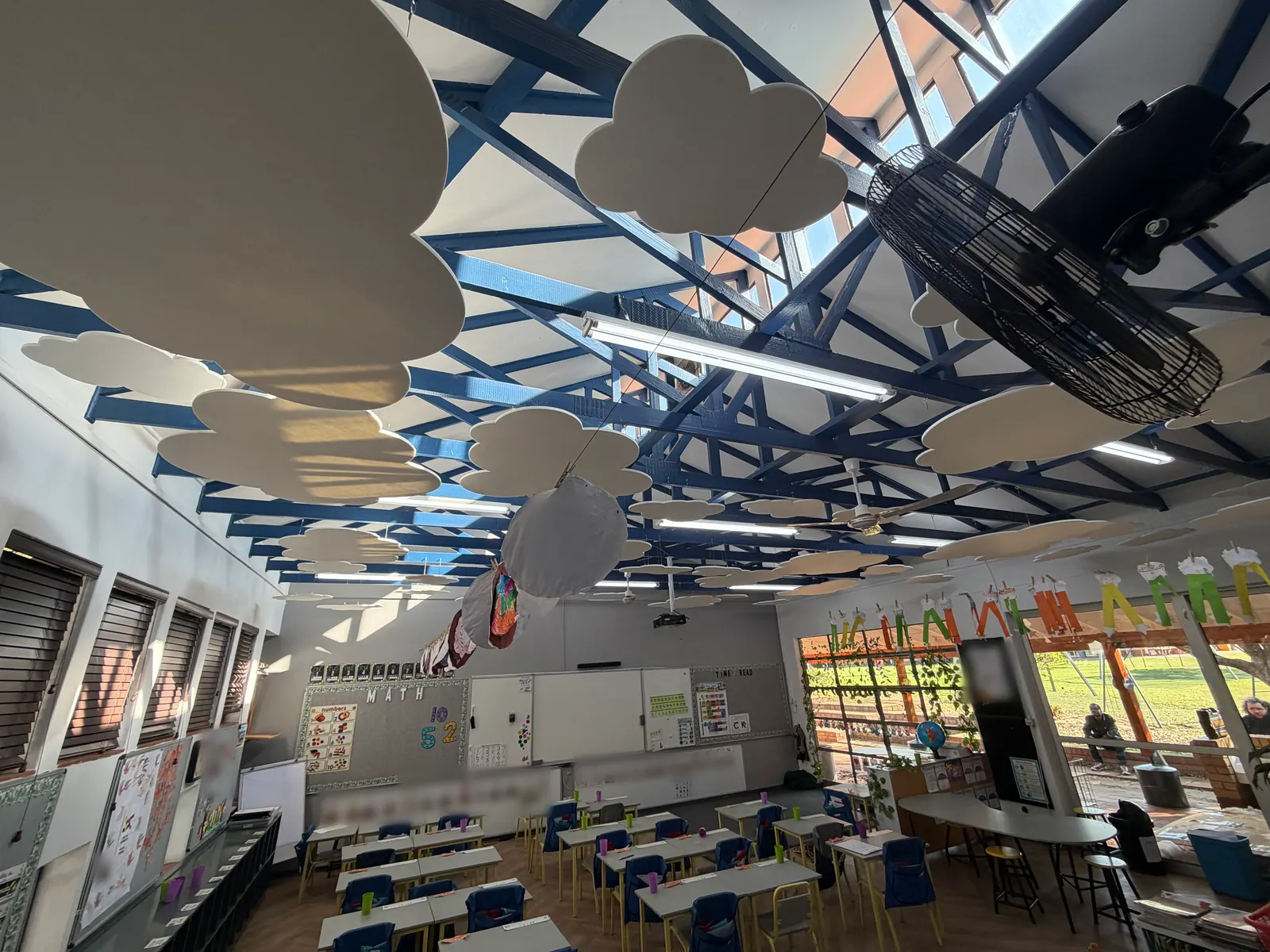
In September 2026, our installation partner measured two rooms at a school in Johannesburg, before and after our felt went up. In Classroom 1, with felt clouds over almost half of the ceiling, the echo dropped from almost a second to a little over half a second: about a third less. In the meeting room, which has wall panels, it dropped by more than a third.
When to ask for help
If the clap test shows about 0.6 seconds or less, your room meets the target for classrooms. Between 0.6 and 0.8 seconds, it is inside the UK's limit for a refurbished classroom but above the target for a new one. Above 0.8 seconds, sound lingers long enough to blur speech, and a room like that usually needs acoustic treatment.
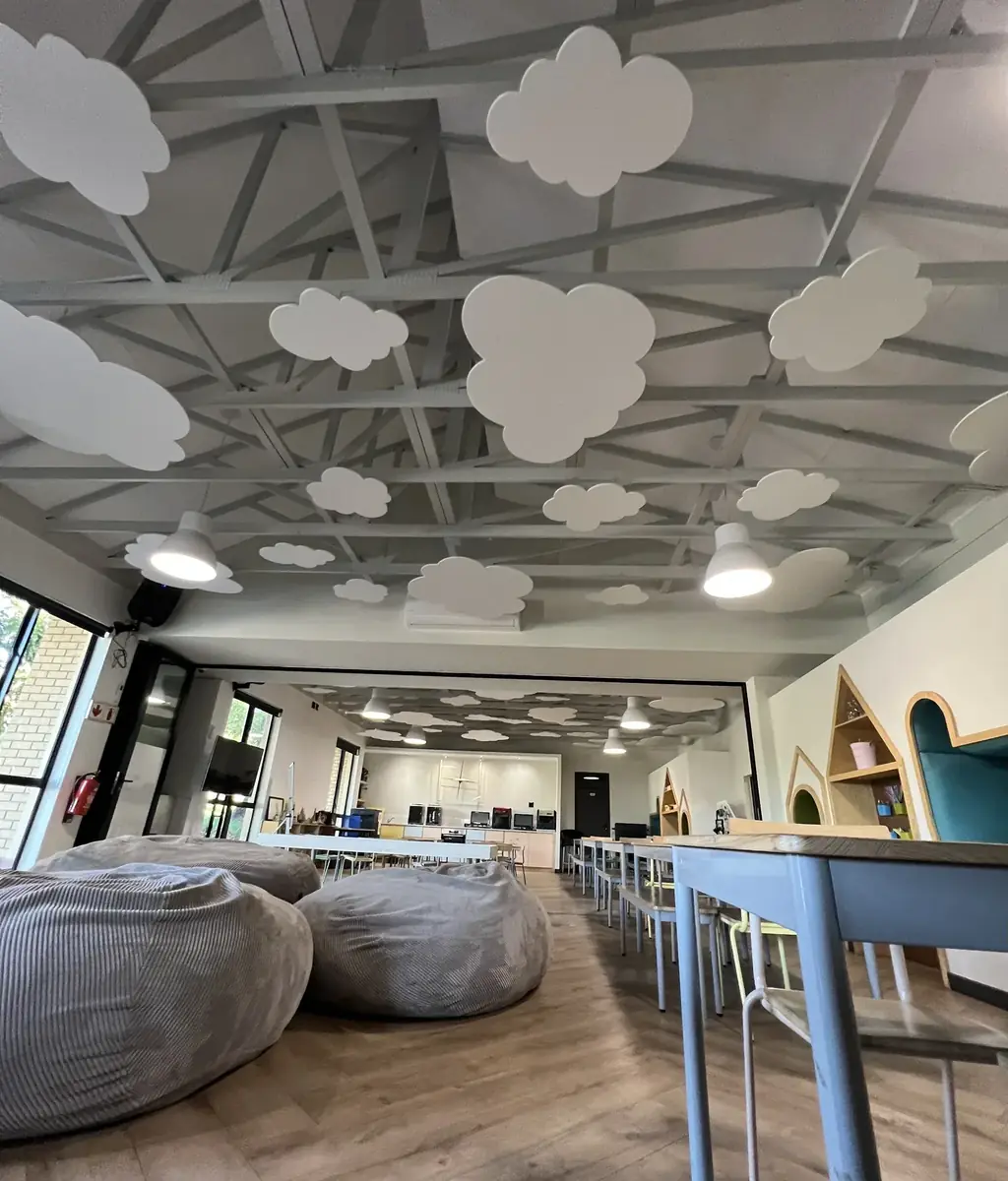
That is where we come in. Sonic Hugs are our felt ceiling clouds and wall panels that take the echo out of a room. They come in three levels, Still, Form and Hush: light, medium and full cover of the ceiling. On a site visit we measure each room, listen to how it is used and recommend the level of Sonic Hugs that suits it. You can hear the difference on our Spaces page.
The numbers, for whoever signs off
Reverberation time (RT60) is the time a sound takes to become 60 decibels quieter after it stops. South Africa's rules set no figure, so the target comes from these:
- The World Health Organization's Guidelines for Community Noise (1999) say a classroom's reverberation time should be about 0.6 seconds, and lower for children with hearing loss.
- The American classroom standard, ANSI/ASA S12.60, allows no more than 0.6 seconds in a typical classroom, furnished but empty.
- The UK's Building Bulletin 93 (2015) asks for 0.6 seconds or less in a new primary classroom, and 0.8 seconds in a refurbished one.
The research on children, noise and reverberation is summed up in two reviews, Klatte, Bergström and Lachmann (2013) and Crandell and Smaldino (2000). Every source, with links, is in the research on our Spaces page.
The clap test works out how fast the echo dies away in four bands of pitch, from 500 Hz to 4 kHz, the range that matters most for speech, and shows the middle of your three results. At the school, our installation partner measured with hand claps and Schroeder backward integration, the same kind of analysis. Classroom 1 (64 m²) is treated at the Form level; the meeting room has wall panels. Averaged from 500 Hz to 4 kHz:
- Classroom 1: 0.92 seconds before, 0.63 seconds after.
- Meeting room: 0.97 seconds before, 0.60 seconds after.
Classroom 1 is now inside the limit for a refurbished classroom, not yet the 0.6 second target for new ones; the meeting room reached 0.6. On recordings of the same two rooms, before and after, the clap test came within 0.04 seconds of our partner's averages each time.