

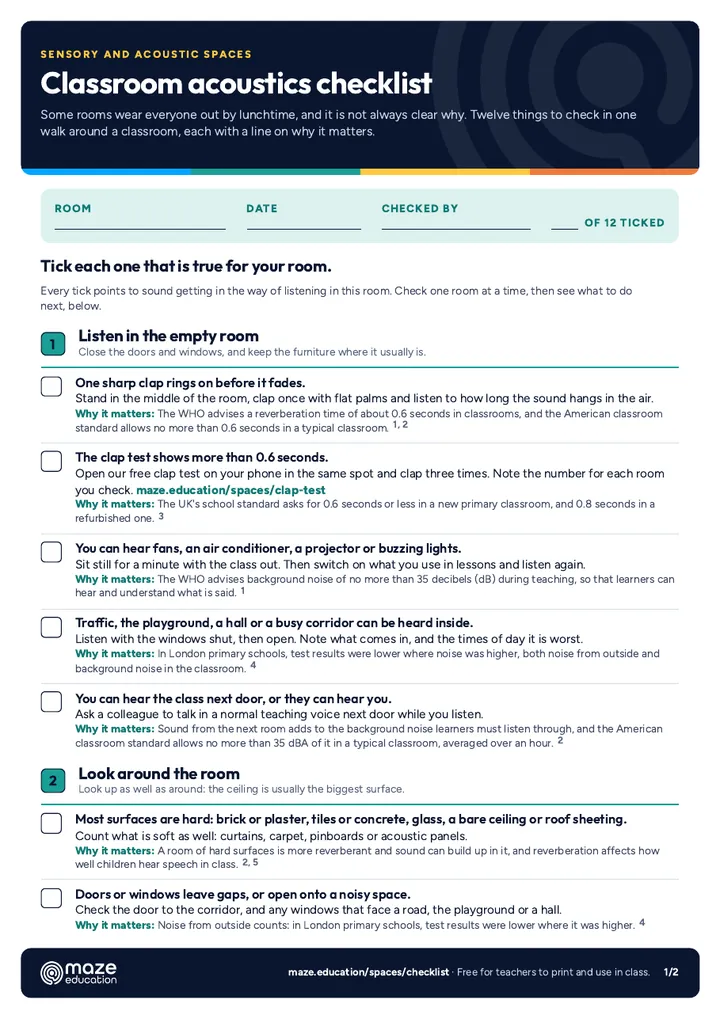
Tick each one that is true for your room.
Every tick points to sound getting in the way of listening in this room. Check one room at a time, then see what to do next, below.
Listen in the empty room
Close the doors and windows, and keep the furniture where it usually is.
Stand in the middle of the room, clap once with flat palms and listen to how long the sound hangs in the air.
Why it matters: The WHO advises a reverberation time of about 0.6 seconds in classrooms, and the American classroom standard allows no more than 0.6 seconds in a typical classroom. (Sources: Guidelines for Community Noise, 1999; ANSI/ASA S12.60, 2010, reaffirmed 2020)
Open our free clap test on your phone in the same spot and clap three times. Note the number for each room you check. maze.education/spaces/clap-test
Open the clap testWhy it matters: The UK's school standard asks for 0.6 seconds or less in a new primary classroom, and 0.8 seconds in a refurbished one. (Source: Building Bulletin 93 (BB93), 2015)
Sit still for a minute with the class out. Then switch on what you use in lessons and listen again.
Why it matters: The WHO advises background noise of no more than 35 decibels (dB) during teaching, so that learners can hear and understand what is said. (Source: Guidelines for Community Noise, 1999)
Listen with the windows shut, then open. Note what comes in, and the times of day it is worst.
Why it matters: In London primary schools, test results were lower where noise was higher, both noise from outside and background noise in the classroom. (Source: Noise and attainment in primary schools, 2008)
Ask a colleague to talk in a normal teaching voice next door while you listen.
Why it matters: Sound from the next room adds to the background noise learners must listen through, and the American classroom standard allows no more than 35 dBA of it in a typical classroom, averaged over an hour. (Source: ANSI/ASA S12.60, 2010, reaffirmed 2020)
Look around the room
Look up as well as around: the ceiling is usually the biggest surface.
Count what is soft as well: curtains, carpet, pinboards or acoustic panels.
Why it matters: A room of hard surfaces is more reverberant and sound can build up in it, and reverberation affects how well children hear speech in class. (Sources: ANSI/ASA S12.60, 2010, reaffirmed 2020; Classroom acoustics for children, 2000)
Check the door to the corridor, and any windows that face a road, the playground or a hall.
Why it matters: Noise from outside counts: in London primary schools, test results were lower where it was higher. (Source: Noise and attainment in primary schools, 2008)
Listen when the class sits down or moves into groups, and look under the chair legs.
Why it matters: In London primary schools, background noise in the classroom was linked to lower test results. (Source: Noise and attainment in primary schools, 2008)
Pace it out. Then sit in the back row while a colleague talks from the front in a normal voice.
Why it matters: Noise, reverberation and the distance between teacher and learner all affect how well children hear speech in class. (Source: Classroom acoustics for children, 2000)
Think about a normal lesson
Answer from what you see most days, not from your best lesson.
Keep a tally for one lesson, and watch for learners who copy what their neighbours do.
Why it matters: Noise makes listening and understanding harder for children than for adults. (Source: Does noise affect learning? 2013)
Think of second-language learners, and children with hearing, language or attention difficulties.
Why it matters: Noise makes listening harder still for second-language learners and children with language or attention difficulties, and the WHO advises less reverberation for children with hearing loss. (Sources: Does noise affect learning? 2013; Guidelines for Community Noise, 1999)
Notice how fast the noise builds, and whether it settles after you ask for quiet.
Why it matters: In a hard, echoey room sound builds up, and noise and reverberation in classrooms were linked to poorer results in verbal tasks. (Sources: ANSI/ASA S12.60, 2010, reaffirmed 2020; Does noise affect learning? 2013)
What next.
All the research, with links to the originals
- Guidelines for Community Noise. Birgitta Berglund, Thomas Lindvall and Dietrich H. Schwela (editors), World Health Organization, 1999.
- ANSI/ASA S12.60 Part 1: Acoustical Performance Criteria, Design Requirements, and Guidelines for Schools. Acoustical Society of America (American National Standard), 2010, reaffirmed 2020.
- Building Bulletin 93: Acoustic design of schools, performance standards. Department for Education, United Kingdom, 2015.
- The effects of environmental and classroom noise on the academic attainments of primary school children. Bridget Shield and Julie Dockrell, Journal of the Acoustical Society of America, 2008.
- Classroom Acoustics for Children With Normal Hearing and With Hearing Impairment. Carl Crandell and Joseph Smaldino, Language, Speech, and Hearing Services in Schools, 2000.
- Does noise affect learning? A short review on noise effects on cognitive performance in children. Maria Klatte, Kirstin Bergström and Thomas Lachmann, Frontiers in Psychology, 2013.