
South Africa's regulations for public school buildings ask for clear speech, and for noise and echo to be kept as low as reasonably practicable. They set no number, so we use the WHO's advice and the UK and American standards.
Source: Department of Basic Education, school infrastructure regulations, 2013, regulation 18Add felt, and hear the room settle.
Sonic Hugs come in three levels: Still, Form and Hush. They cover about 35%, 45% or 65% of the ceiling. Light cover suits a room that is lively but workable; full cover suits a hall or the loudest room in the school.
Brick, prefab or mobile classroom, the felt hangs from what is already there. A site visit comes before any quote, so the level we suggest fits the real room and your budget.
See the difference
Slide felt into the room and watch the echo settle. The ballpark for your rooms follows the slider.
Before: no felt
Move the slider to add felt
Same classroom. Same clap. A third less echo.
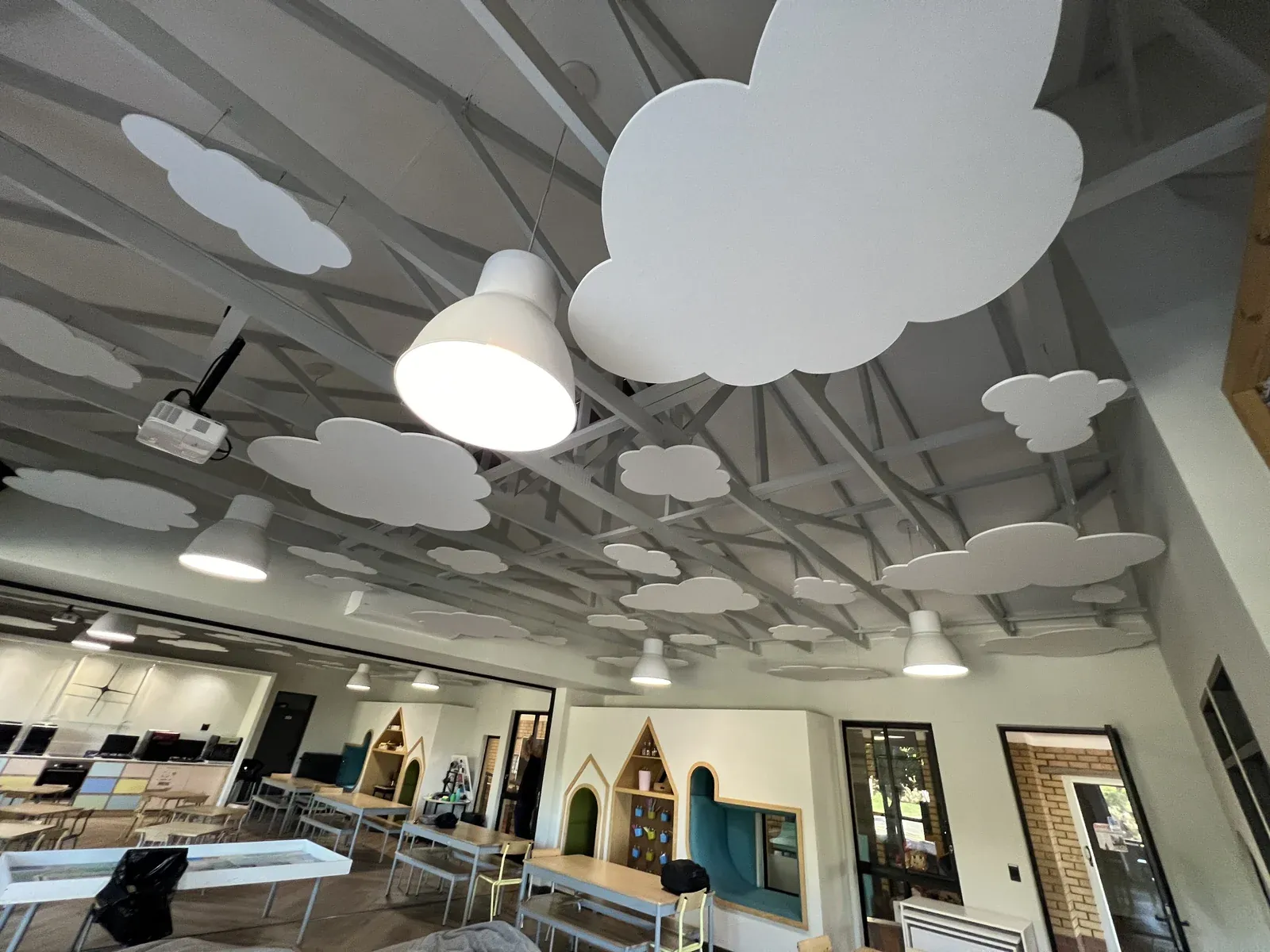
At a school in Johannesburg we hung 43 felt clouds over almost half the ceiling of a classroom, and panels on the walls of a meeting room. The echo in the classroom dropped from almost a second to a little over half a second. Listen to one clap in each room, before and after.
Hear the difference
One hand clap in the same room, recorded before and after the felt went up.
Seconds after the clap. Each shape is the clap's echo in the recording, drawn until it fades into the room's background noise.
About a third less echo, in a real classroom.
Best with headphones.
- Narrator: Before installation.
- [One hand clap. The echo rings on for most of a second before it fades into the room's background noise.]
- Narrator: After installation.
- [One hand clap. The echo fades into the background noise in a little over half a second.]
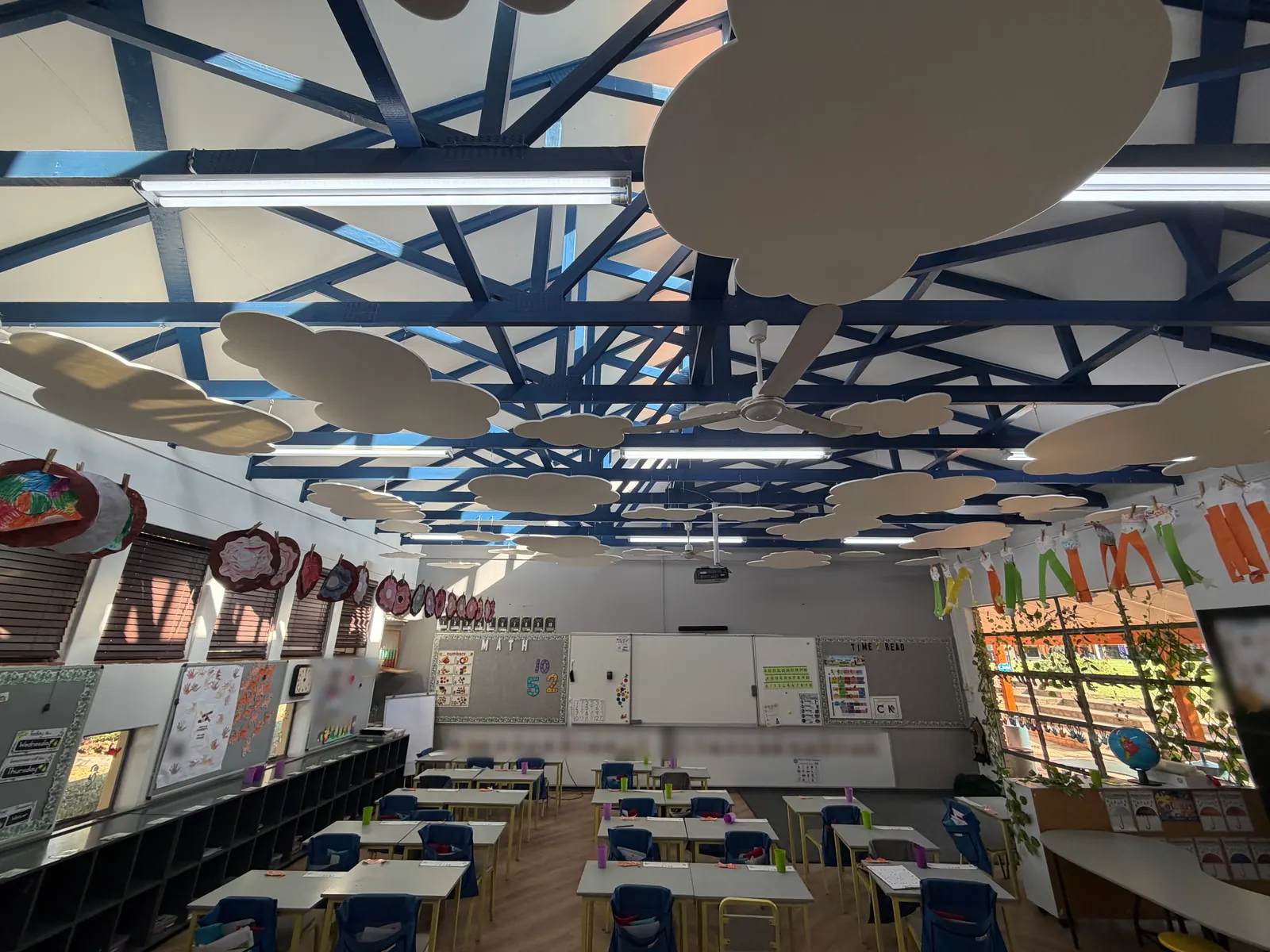
Classroom 1: felt clouds over almost half of the ceiling 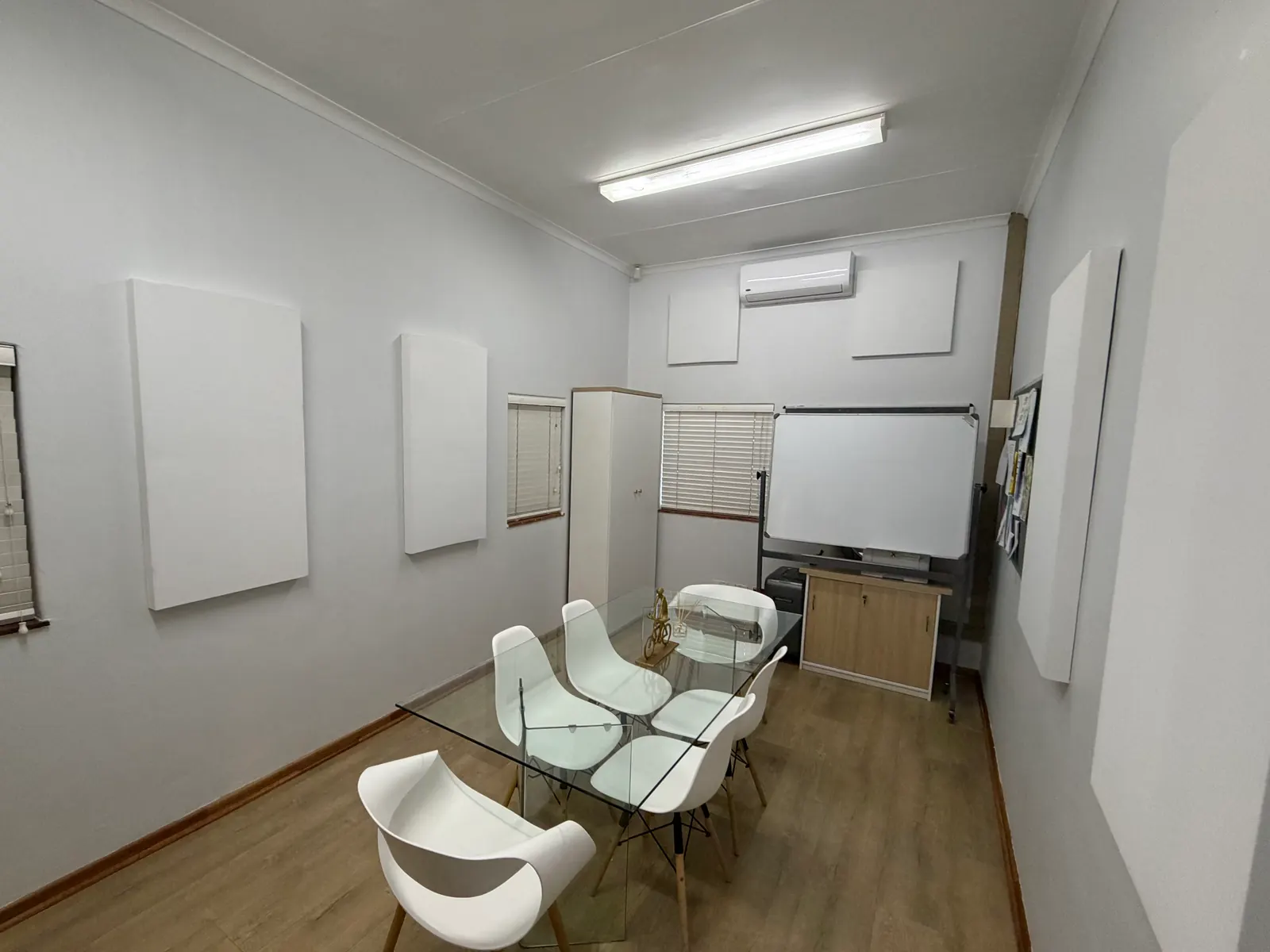
The meeting room: eight wall panels
Why a third less echo matters.
Children find it harder than adults to listen and understand through noise and echo. Second-language learners, and children with language or attention difficulties, find it harder still.
Source: Klatte, Bergström and Lachmann, 2013How well a child hears the teacher depends on the noise in the room, how long sound lingers, and how far away they sit.
Source: Crandell and Smaldino, 2000Guidelines for classrooms aim for about 0.6 seconds of echo or less. Classroom 1 started at almost a second.
Source: WHO, 1999
Felt that looks like it belongs.
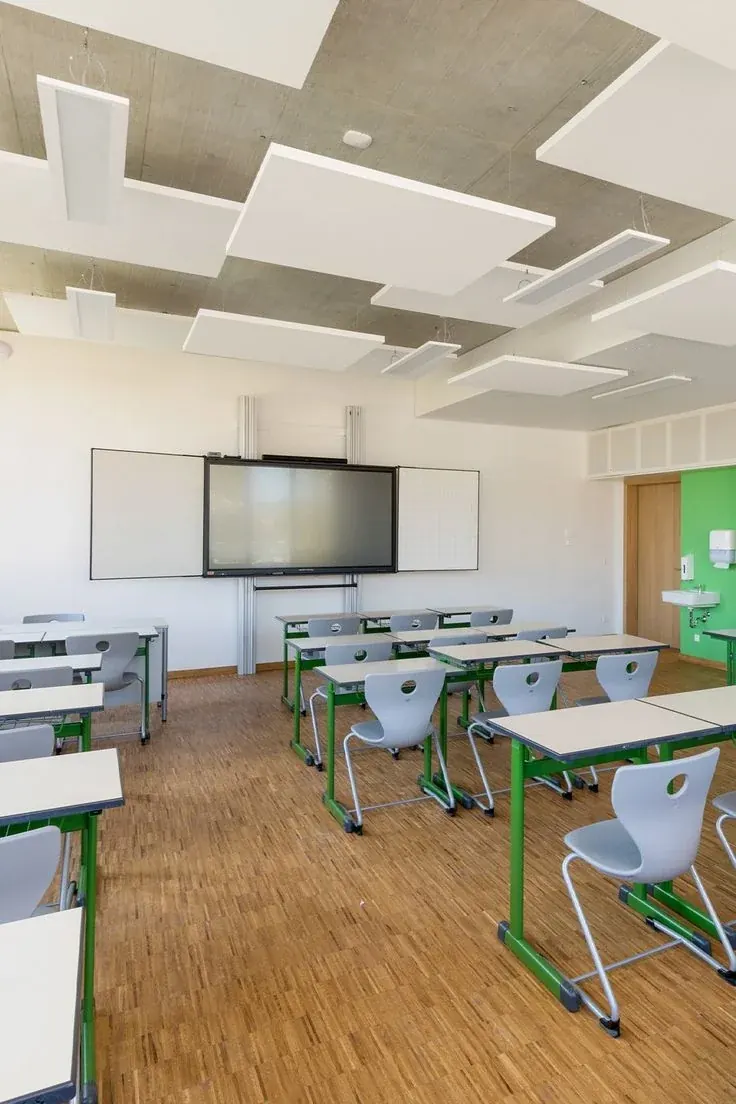
Clouds, baffles and wall panels cut from felt made from recycled PET plastic, in your school's colours and shapes. They are light to hang, and nothing is rebuilt. We supply and install them with our installation partner.
Shapes and colours
Ceiling panels 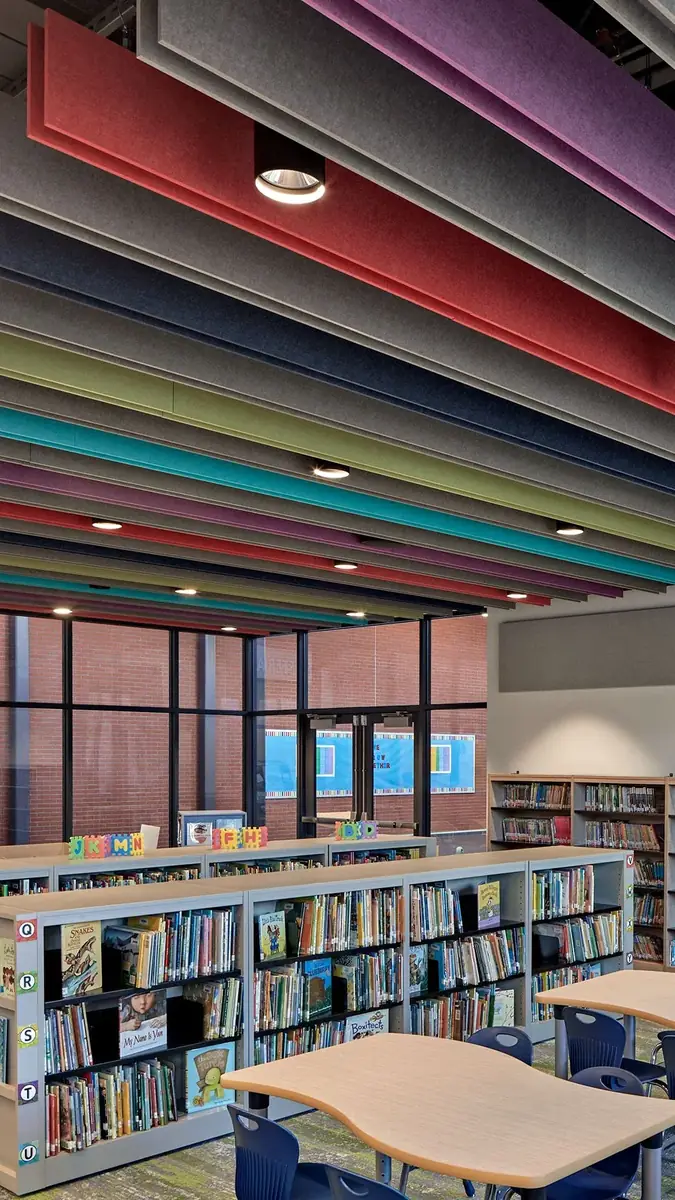
Colour baffles 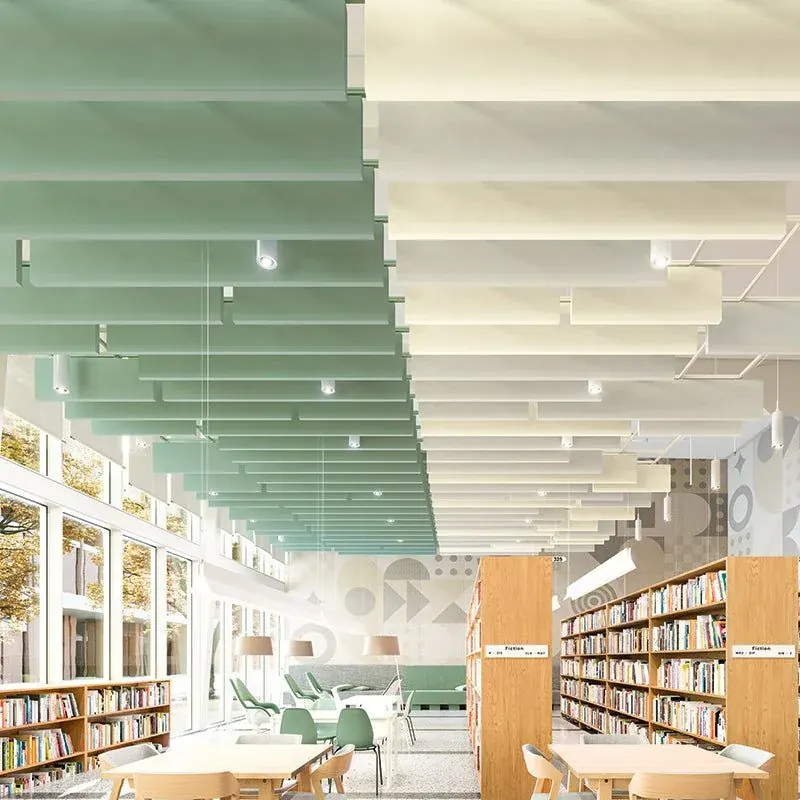
Library baffles 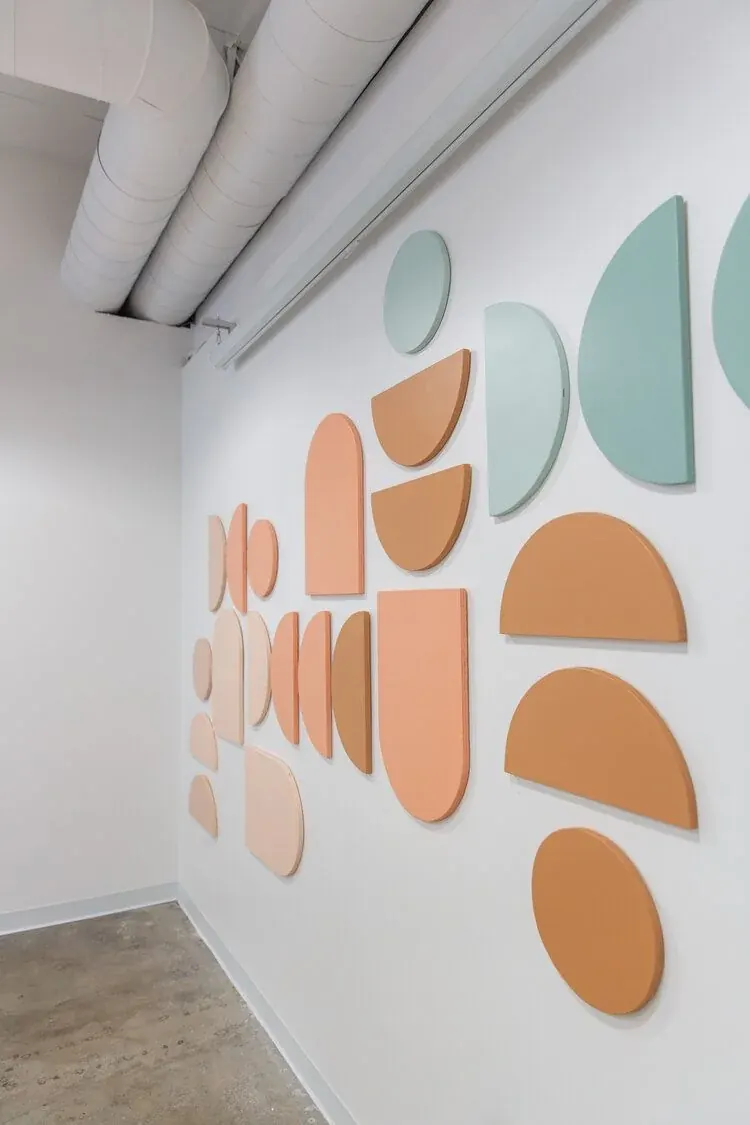
Wall shapes 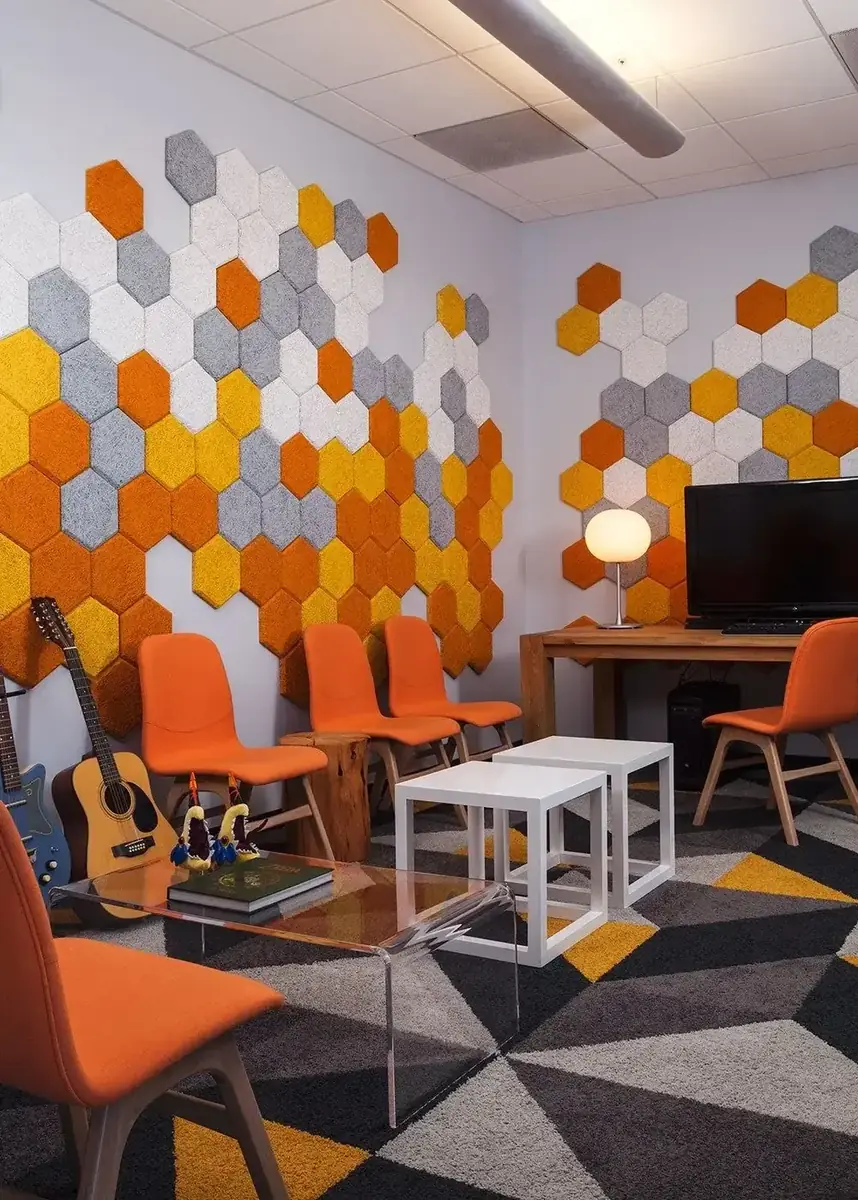
Hexagon wall panels
Styles from our installation partner's range. We match colours and shapes to your school.
Room to reset.
Some learners need a moment away from the noise before they can come back to the lesson. A sensory corner gives them that inside the classroom, with softer sound and light. We plan it with you, alongside any felt the room needs.
From first call to a calm room.
- TalkTell us which rooms are hard to teach in and how they are used.
- VisitWe come out, listen to each room, measure it and talk to the people who use it.
- PlanA written report and a quote for each room, with options for different budgets.
- Install and checkUsually without disrupting teaching. Afterwards we come back to check how each room sounds in daily use.
What your written report covers
Every school gets written feedback after a site visit, so you can plan and budget with the facts in front of you, and pass it to whoever signs off the work.
The roomsEach room we visited, how it is used and its measurements.
What we foundWhat we saw and heard in each room, in plain language.
What we recommendOur recommendation for each room at each level, Still, Form and Hush, so you can choose what fits your budget.
Questions about sound and installation
What happens at a site visit?
We visit your school, listen to the rooms, measure them and talk to the people who use them. Afterwards you get written feedback and a quote with a breakdown per room, with options for different budgets. From R 1 800 excl. VAT (R 2 070 incl. VAT) for the visit, and it comes off the cost of the work if your school goes ahead with the installation. We confirm the fee in writing when you book, before we come out.
Does it mean building work?
No. Ceiling clouds, wall panels and sensory corners work in brick, prefab and mobile classrooms. We look at the space first and recommend what fits your budget.
What is Sonic Hugs?
Sonic Hugs is our name for the felt ceiling clouds, baffles and wall panels we hang in schools. They soak up echo, so speech is clearer and rooms feel calmer. There are three levels of cover, Still, Form and Hush, and we supply and install them with our installation partner.
How are the colours and shapes chosen?
From our installation partner's range of shapes and colours. We match them to your school, so the design is in your colours and shapes.
Will installation disrupt lessons?
Installation usually happens without disrupting teaching. Afterwards we come back to check how each room sounds in daily use.
Do you work outside Gauteng?
Yes. We work with schools across South Africa. Tell us where your school is and we plan the visit with you.
From R 1 800 excl. VAT (R 2 070 incl. VAT) for the visit, and it comes off the cost of the work if your school goes ahead with the installation.
Book a site visit →Technical details and research.
For whoever needs the numbers: a governing body, a facilities manager or an architect. The benchmarks we measure against, the measurements behind the case study, what the felt is made of, and every source we rely on.
Classroom benchmarks, and where the school's rooms sit
South African rulesNo figure UK school standard0.8 s BB93's reverberation benchmark for refurbished primary classrooms. New primary classrooms have a stricter 0.6 s benchmark. These are room-specific targets, not a universal limit or proof that a hand-clap estimate complies.
Source: UK Department for Education, BB93, 2015, Table 6World Health Organization35 dB The most background noise the WHO advises during lessons, with a reverberation time of about 0.6 s, preferably lower for children with hearing loss.
Source: WHO Guidelines for Community Noise, 1999American classroom standard0.6 s The most reverberation ANSI/ASA S12.60 allows in a typical classroom of up to 283 m³, furnished but empty, with background noise of no more than 35 dBA averaged over an hour.
Source: ANSI/ASA S12.60, 2010, reaffirmed 2020
Targets at a glance
Reverberation time in seconds: how long sound lingers. Further left is less echo.
- 0.8 sRefurbished primary classrooms (BB93).
- 0.6 sNew primary classrooms (BB93) and typical classrooms (ANSI/ASA S12.60). The WHO advises about 0.6 s.
Our installation partner measured before and after in September 2026. Classroom 1 fell from 0.92 s to 0.63 s, 32% less echo. These plotted averages use four frequencies (500 Hz to 4 kHz); BB93 compares three (500 Hz, 1 kHz and 2 kHz), giving 0.67 s after treatment in Classroom 1. That is below the 0.8 s refurbishment benchmark, not the 0.6 s new-build benchmark. Hand-clap estimates are not a formal compliance test.
| Room | Before | After |
|---|---|---|
| Classroom 1 | 0.92 s | 0.63 s |
| Meeting room | 0.97 s | 0.60 s |
| Learning hall | 1.61 s | 0.78 s |
Measured results, room by room
Reverberation time (RT60) is how long sound takes to fade by 60 dB. The lower it is, the less a room echoes and the clearer speech is.
Classroom 1
8 m by 8 m (64 m²) · Form level, 45% ceiling coverage
Before0.92 s
After0.63 s
less echo0.29 s shorter
With 43 white felt clouds covering 45% of the ceiling, echo fell from 0.92 s to 0.63 s, 32% less. The report averages four frequencies from 500 Hz to 4 kHz. Across the three frequencies used by the UK's BB93 classroom standard, the after figure is 0.67 s: below its 0.8 s refurbishment benchmark, though above the 0.6 s new-build benchmark. This hand-clap estimate is not a formal compliance test.
By frequency
Dashed lines show BB93's 0.8 s refurbishment and 0.6 s new-build benchmarks for primary classrooms. BB93 compares the average of 500 Hz, 1 kHz and 2 kHz, not each band on its own; this chart and hand-clap estimate do not prove compliance.
What we installed: Felt clouds cut from white 12 mm PET felt: 13 large (1200 by 1200 mm) and 30 small (600 by 600 mm).
| Frequency | Before | After | Change |
|---|---|---|---|
| 500 Hz | 0.97 | 0.73 | 0.24 s shorter, 25% less |
| 1 kHz | 0.96 | 0.68 | 0.28 s shorter, 29% less |
| 2 kHz | 0.92 | 0.59 | 0.33 s shorter, 36% less |
| 4 kHz | 0.83 | 0.52 | 0.31 s shorter, 37% less |
| Average, 500 Hz to 4 kHz | 0.92 | 0.63 | 0.29 s shorter, 32% less |
Meeting room
Wall-mounted panels
Before0.97 s
After0.60 s
less echo0.37 s shorter
Down to 0.60 s, with the biggest gains at 500 Hz and 1 kHz, where most of the energy in the spoken voice sits.
By frequency
Dashed lines show BB93's 0.8 s refurbishment and 0.6 s new-build benchmarks for primary classrooms. BB93 compares the average of 500 Hz, 1 kHz and 2 kHz, not each band on its own; this chart and hand-clap estimate do not prove compliance.
What we installed: Eight wall-mounted panels: four 1200 by 600 mm mineral wool panels (50 mm) and four 600 by 600 mm panels.
| Frequency | Before | After | Change |
|---|---|---|---|
| 500 Hz | 0.98 | 0.57 | 0.41 s shorter, 42% less |
| 1 kHz | 1.01 | 0.58 | 0.43 s shorter, 43% less |
| 2 kHz | 0.96 | 0.65 | 0.31 s shorter, 32% less |
| 4 kHz | 0.91 | 0.59 | 0.32 s shorter, 35% less |
| Average, 500 Hz to 4 kHz | 0.97 | 0.60 | 0.37 s shorter, 38% less |
The school's learning hall, a hall-like space of 128 m² treated at Still level (35% coverage), went from 1.61 s to 0.78 s.
Measured by our installation partner in September 2026: a hand clap in each room, analysed to estimate echo time from a recording (at two positions in Classroom 1). RT60 is the time sound takes to fade by 60 dB; each reported average covers 500 Hz to 4 kHz. BB93 compares 500 Hz, 1 kHz and 2 kHz in a finished, furnished but unoccupied room. These recordings have not been established as a formal BB93 compliance test.
What the felt is made of, and the documents
Our clouds and wall panels are cut from PET felt: felt made from recycled PET plastic, bonded with heat. Here is what our supplier's product information says about it, and what it did in a real classroom.
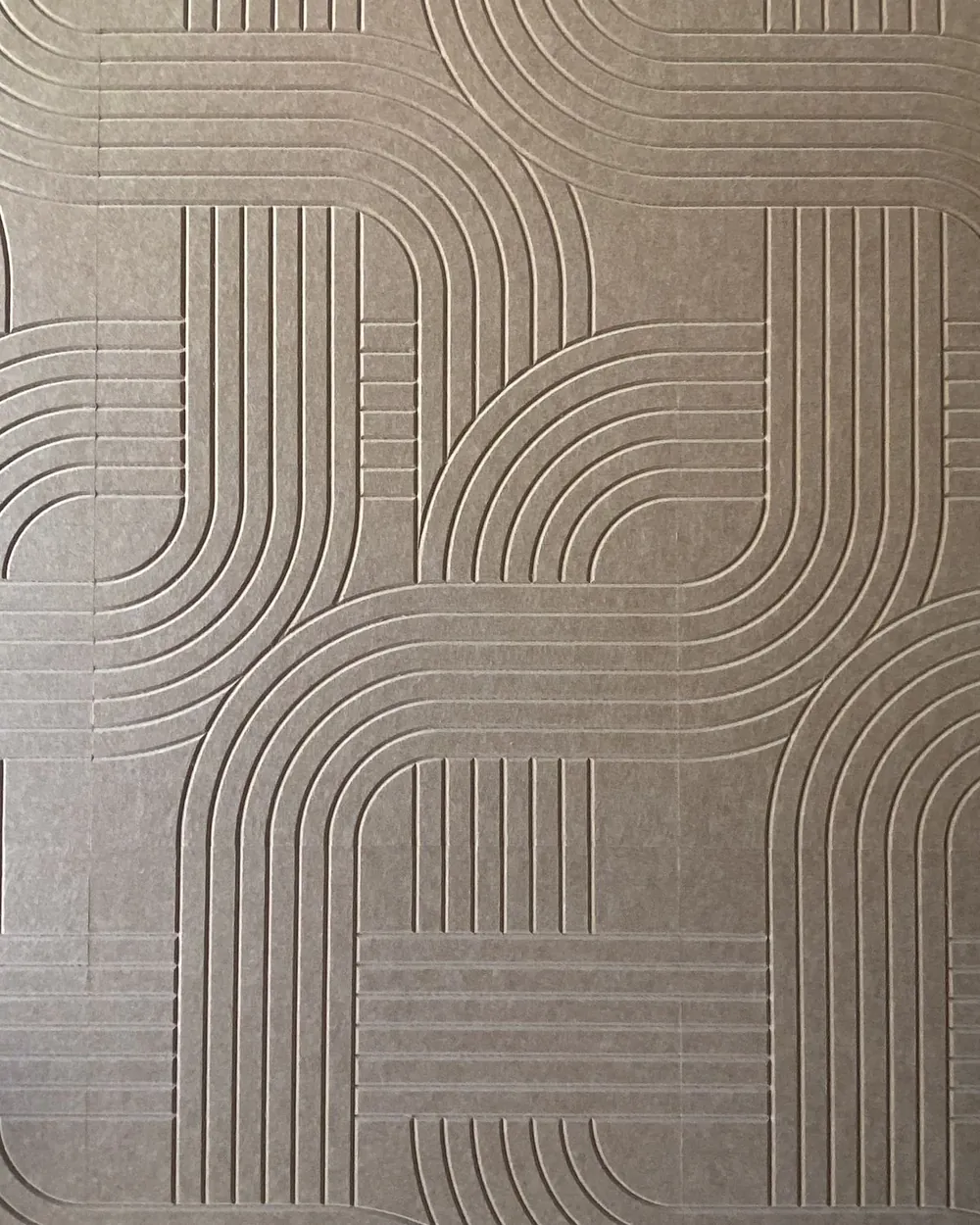
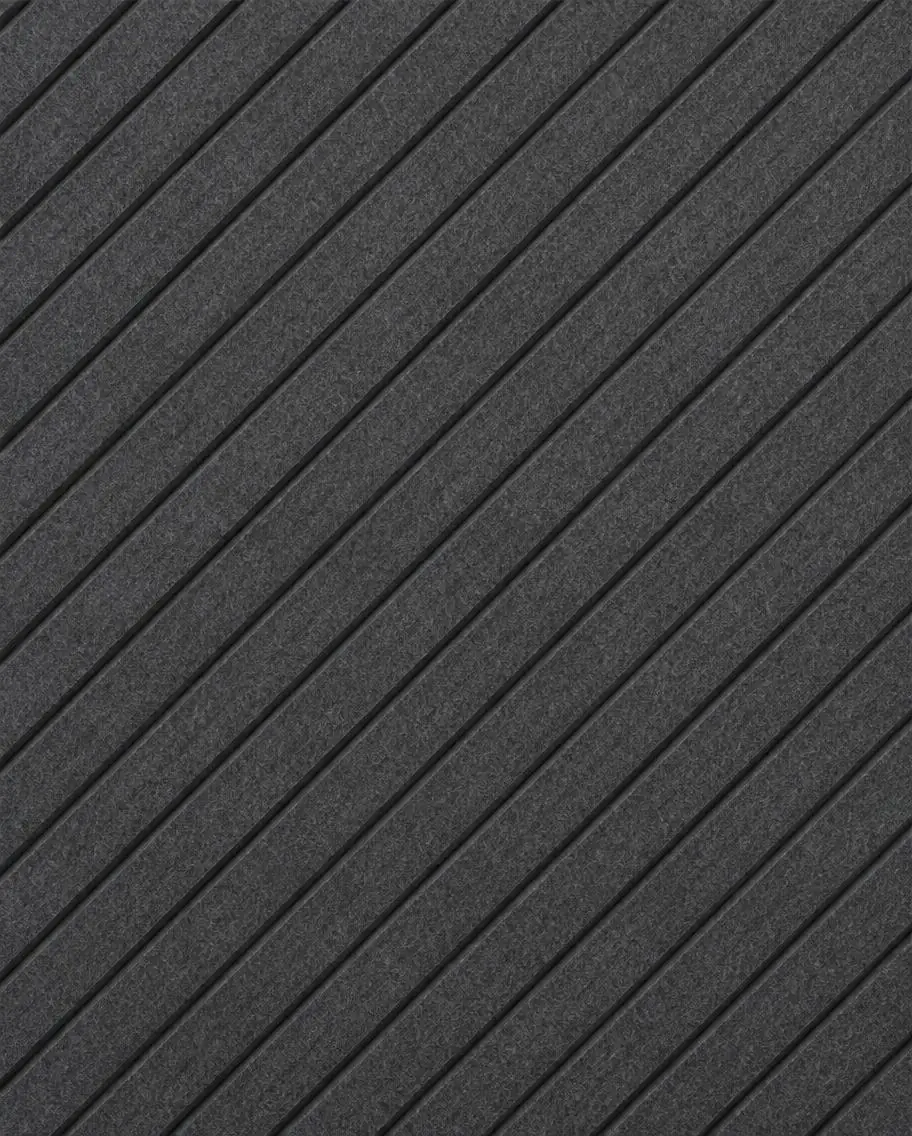
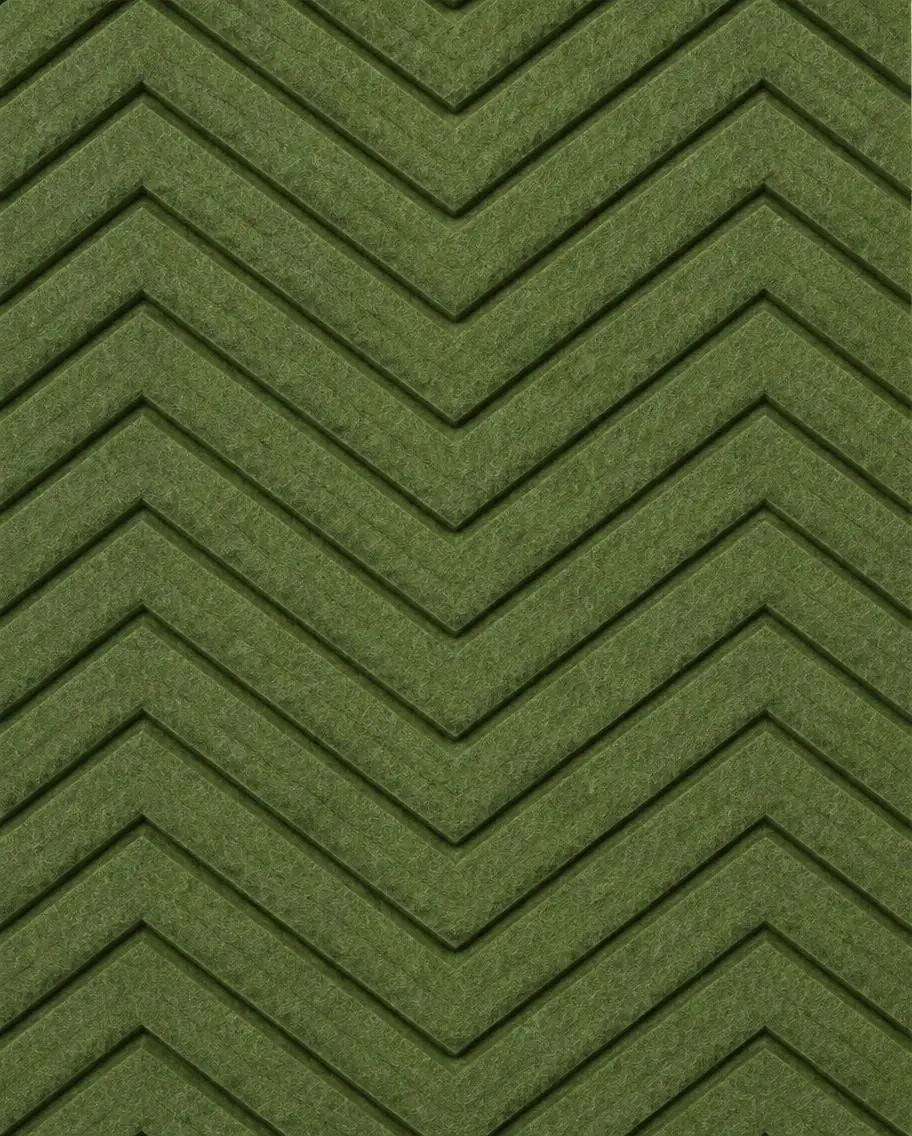
Illustrative pattern studies, not supplier samples. Ask us which routed patterns and colours are available for your room.
The felt, in short
Recycled PET plastic
Made from recycled PET plastic. The fibres are bonded with heat into a dense, non-woven felt.
Your shapes
Cut by CNC machine into clouds, circles, hexagons or your own shapes, with grooves routed into the face if you want them.
48 colours
Three thicknesses, 12, 18 and 24 mm, in 48 colours.
Light to hang
Lightweight, for clouds hung from the roof or ceiling and panels fixed to walls.
Keeps its shape
Resists damp and holds its shape.
Our 30 mm hanging baffles
We also hang baffles in bigger spaces. The technical file for our 30 mm baffles says:
- A core made entirely from recycled PET plastic.
- Hard-wearing, UV resistant, humidity resistant and easy to clean.
Ask us for the documents behind any of this.
Get a quote →From our supplier's product information and technical file, read in October 2026, and the measurements at a school in Johannesburg, September 2026. Why we use PET felt in classrooms
All the research, with links to the originals
Regulation2013 As low as practicable
background noise and reverberation in public schools
School infrastructure norms
Speech between teacher and learners should be clear. The regulations give no figures.
Department of Basic Education, South Africa
Regulations relating to minimum uniform norms and standards for public school infrastructure
By Department of Basic Education, South Africa, Government Notice R. 920, Government Gazette 37081, 2013.
South Africa's rules for public school buildings ask that acoustic conditions, as far as reasonably practicable, allow clear speech between teacher and learners and between learners, and that background noise and reverberation be reduced to a minimum (regulation 18(9) and (10)). They give no figures for either.
Read the sourceThe Government Gazette copy on the Department of Basic Education's website. The acoustics clauses are regulation 18(9) and (10).Review2017 0.6 to 0.7 s
the echo time in the DBE's 2012 school planning guidelines
Classroom acoustics in South Africa
SANS 10103 sets no echo time. The authors call for the rules to be revised to include learners with disabilities.
South African Journal of Communication Disorders
Classroom acoustics as a consideration for inclusive education in South Africa
By Coralie van Reenen and Catherine Karusseit, South African Journal of Communication Disorders, 2017.
A review of South Africa's rules on classroom sound against the research. The rules range from 35 to 50 dBA for background noise and say little about reverberation time: the Department of Basic Education's 2012 planning guidelines suggest 0.6 to 0.7 seconds, and SANS 10103 sets none. Most research agrees that about 0.6 seconds suits most learners and that learners with hearing loss need a shorter time, so the authors call for the rules to be revised to include learners with disabilities.
Read the sourcePDFGuideline1999 35 dB
the most background noise during lessons
Guidelines for Community Noise
With reverberation of about 0.6 s, preferably lower for children with hearing loss.
World Health Organization
Guidelines for Community Noise
By Birgitta Berglund, Thomas Lindvall and Dietrich H. Schwela (editors), World Health Organization, 1999.
To hear and understand what is said in class, background noise during teaching should not go above 35 dB, and the reverberation time (how long sound lingers in the room) should be about 0.6 seconds, preferably lower for children with hearing loss.
Read the sourcePDFStandard2010, reaffirmed 2020 0.6 s
the most reverberation in a typical classroom
ANSI/ASA S12.60
With background noise of no more than 35 dBA, averaged over an hour.
Acoustical Society of America
ANSI/ASA S12.60 Part 1: Acoustical Performance Criteria, Design Requirements, and Guidelines for Schools
By Acoustical Society of America (American National Standard), 2010, reaffirmed 2020.
The American standard for classroom acoustics. In a typical classroom (up to 283 m³) it allows background noise of no more than 35 dBA, averaged over an hour, and, in the furnished but empty room, a reverberation time of no more than 0.6 seconds.
Read the sourcePDFLinks to the free booklets the ASA publishes on the standard. The full standard is sold by ANSI.Standard2015 0.6 s
or less in a new primary classroom
Building Bulletin 93 (BB93)
0.8 s or less in a refurbished one. Background noise: up to 35 dB new, 40 dB refurbished.
Department for Education, United Kingdom
Building Bulletin 93: Acoustic design of schools, performance standards
By Department for Education, United Kingdom, 2015.
The UK's acoustic standards for school buildings. A new primary classroom should have no more than 35 dB of background noise and a reverberation time of 0.6 seconds or less; for a refurbished classroom the limits are 40 dB and 0.8 seconds.
Read the sourcePDFReview2013 Children
find listening in noise harder than adults do
Does noise affect learning?
Harder still for children with language or attention difficulties and for second-language learners.
Frontiers in Psychology
Does noise affect learning? A short review on noise effects on cognitive performance in children
By Maria Klatte, Kirstin Bergström and Thomas Lachmann, Frontiers in Psychology, 2013.
Noise makes listening and understanding harder for children than for adults, and harder still for children with language or attention difficulties and for second-language learners. Noise and reverberation in classrooms were linked to poorer results in verbal tasks.
Read the sourcePDFStudy2008 Lower results
in national tests where noise was higher, in London primary schools
Noise and attainment in primary schools
The link held after allowing for social deprivation, language and special educational needs.
Journal of the Acoustical Society of America
The effects of environmental and classroom noise on the academic attainments of primary school children
By Bridget Shield and Julie Dockrell, Journal of the Acoustical Society of America, 2008.
In London primary schools, children's national test results were lower where noise was higher, both noise from outside and background noise in the classroom. The link held after allowing for social deprivation, language and special educational needs.
Read the sourceOpen-access copy in UCL's research repository.Review2000 Noise, echo, distance
all affect how well children hear speech in class
Classroom acoustics for children
Whether their hearing is typical or they have a hearing loss. The authors suggest acoustic criteria for classrooms.
Language, Speech, and Hearing Services in Schools
Classroom Acoustics for Children With Normal Hearing and With Hearing Impairment
By Carl Crandell and Joseph Smaldino, Language, Speech, and Hearing Services in Schools, 2000.
Noise, reverberation and the distance between teacher and learner all affect how well children hear speech in class, whether their hearing is typical or they have a hearing loss. The authors suggest acoustic criteria for classrooms.
Read the source
Is one of your rooms hard to teach in?
Tell us about the room and how it is used. If a site visit would help, we arrange one.
What happens next
- We reply within one working day.
- If it helps, we set up a free 20-minute call about your school.
- Anything with a cost, we price in writing before it is booked.
Prefer to pick a time? See the calendar →